




News and Updates!
The Elder Ras Prince High Court Case: Why South Africa’s Cannabis Community Is Watching Closely
May
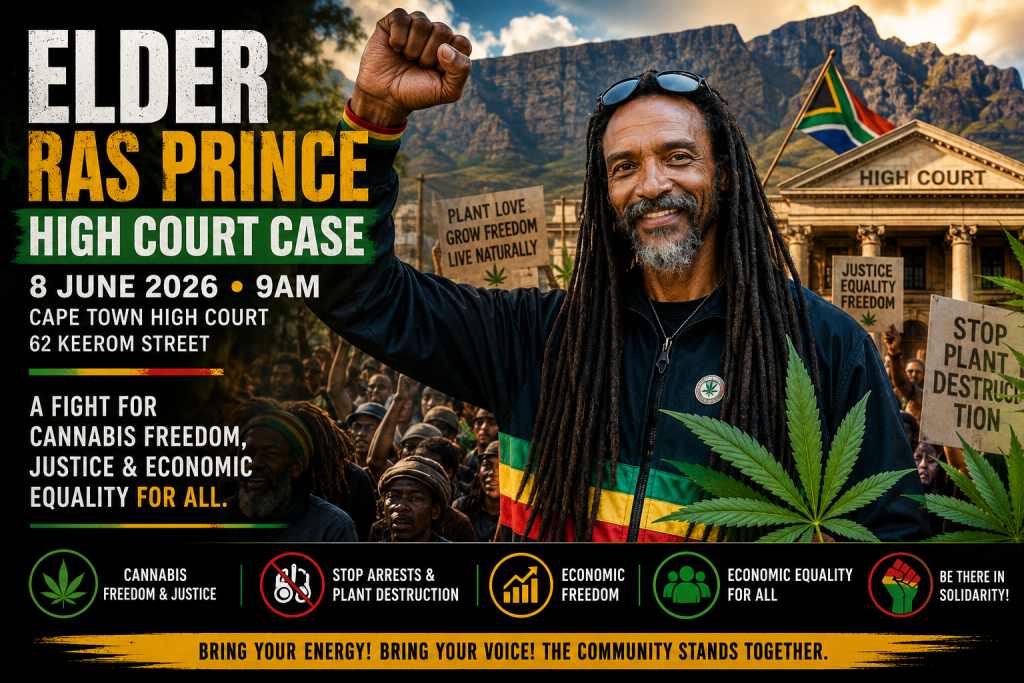
On 8 June 2026, supporters from across South Africa’s cannabis community are expected to gather outside the Cape Town High Court in solidarity with Elder Ras Prince, a long-standing cannabis activist, spiritual advocate, and voice for cannabis freedom.
The hearing, taking place at 62 Keerom Street, Cape Town, has already become far more than a courtroom appearance. For many people, this case represents a larger struggle around constitutional rights, economic inclusion, cultural freedom, traditional medicine, and the future of South Africa’s cannabis industry.
For the cannabis community, this is not just another legal matter.
It is a defining moment.
Who Is Elder Ras Prince?
Elder Ras Prince has become one of the most recognized public figures connected to cannabis rights activism in South Africa.
For years, he has openly advocated for:
- The decriminalization of cannabis
- The protection of Rastafarian spiritual rights
- Economic inclusion for traditional growers and small cannabis communities
- Fair cannabis legislation that benefits ordinary South Africans rather than only large corporations
His activism has consistently focused on the idea that cannabis should not remain criminalized in ways that disproportionately affect marginalized communities while commercial opportunities increasingly emerge for wealthy investors and licensed operators.
To many supporters, Elder Ras Prince represents resistance against unequal cannabis laws and selective enforcement.
The Bigger Background: Cannabis Laws in South Africa
South Africa’s cannabis legal landscape has changed dramatically over the past decade — but many believe the system remains incomplete and deeply unequal.
The 2018 Constitutional Court Ruling
In 2018, South Africa’s Constitutional Court made global headlines when it ruled that adults may legally:
- Use cannabis privately
- Possess cannabis for personal consumption
- Cultivate cannabis privately for personal use
The ruling was widely celebrated as a historic victory for personal freedom and privacy rights.
However, the ruling also left major unanswered questions.
While private use became protected, many issues remained unclear:
- What qualifies as “private”?
- How much cannabis is considered personal use?
- What rights do traditional growers have?
- Can communities economically benefit from cannabis?
- Why are arrests still happening?
- Why is cannabis trade still heavily restricted?
This legal grey area created ongoing tension between communities, law enforcement, regulators, and cannabis activists.
Why Activists Say The Fight Is Not Over
Many cannabis advocates argue that South Africa has entered a confusing “partial legalization” phase where:
Private Use Is Allowed…
…but broader cannabis participation remains heavily restricted.
People may legally consume cannabis privately, yet:
- Small growers still face pressure
- Informal cannabis traders remain vulnerable
- Traditional communities often lack legal protection
- Economic opportunities are concentrated among licensed corporate players
This has led to criticism that legalization has benefited larger commercial interests more than the communities historically connected to cannabis cultivation.
The Rastafarian Perspective
For Rastafarian communities, cannabis is not simply a commercial product.
It is considered:
- A sacrament
- A spiritual herb
- Part of cultural identity
- A religious practice
For decades, Rastafarians faced arrests, criminal records, social stigma, and discrimination connected to cannabis use.
Many supporters of Elder Ras Prince believe this case continues a broader struggle for spiritual freedom and equal constitutional protections.
Economic Freedom & Cannabis
One of the strongest themes surrounding this case is economic inclusion.
South Africa’s cannabis industry has enormous potential:
- Cultivation
- Wellness products
- Retail
- Hemp products
- Tourism
- Medical cannabis
- Lifestyle brands
- Export opportunities
Yet many activists argue that ordinary South Africans — especially historically disadvantaged communities — are being excluded from meaningful participation.
The concern is that cannabis legalization could evolve into a system where:
- Large corporations dominate licensing
- Small growers are regulated out
- Traditional knowledge is ignored
- Wealth creation bypasses the communities that carried the cannabis culture for generations
For many supporters, this hearing symbolizes resistance against that outcome.
Why The 8 June 2026 Hearing Matters
The public support campaign surrounding the hearing focuses on several key issues:
Cannabis Freedom & Justice
Supporters believe cannabis users and growers should not continue facing arrests or criminal targeting under inconsistent legal frameworks.
Stop Plant Destruction
Activists oppose the destruction of cannabis crops and argue that traditional growers deserve protection and pathways into the legal economy.
Economic Equality
Many believe cannabis legalization should create opportunities for all South Africans — not only wealthy investors.
Constitutional Rights
Supporters argue that privacy rights, spiritual freedom, and economic participation must all be considered together.
A Defining Moment For South Africa’s Cannabis Industry
South Africa stands at a crossroads.
The country has the opportunity to build one of the world’s most unique cannabis industries — one rooted in:
- African cultivation heritage
- Small-scale farming
- Indigenous knowledge
- Community ownership
- Wellness
- Tourism
- Lifestyle culture
But the direction chosen now could shape the industry for decades.
Will the future cannabis economy include ordinary communities?
Or will it become centralized around large-scale corporate control?
That debate sits at the center of many conversations surrounding the Elder Ras Prince case.
Community Mobilization & Public Support
The June 8 hearing is expected to draw supporters from across the cannabis, Rastafarian, wellness, and civil rights communities.
Organizers are encouraging peaceful public solidarity outside the Cape Town High Court.
The message behind the campaign is clear:
Cannabis freedom must include justice, dignity, economic opportunity, and equal rights for the communities that carried this culture long before legalization became commercially attractive.
The Future Of Cannabis In South Africa
Regardless of the legal outcome, the Elder Ras Prince hearing reflects something much bigger happening inside South Africa.
The cannabis conversation is evolving from:
“Should cannabis be legal?”
to:
“Who benefits from legalization?”
That question may ultimately define the future of the South African cannabis industry.
And on 8 June 2026, many eyes will be on the Cape Town High Court.
Stand In Solidarity
📍 Cape Town High Court
62 Keerom Street, Cape Town
📅 8 June 2026
⏰ 9:00 AM
Supporters are encouraged to attend peacefully and stand with the broader movement for cannabis justice, economic freedom, and equal rights.

I met Elder Ras Prince in Cape Town recently and to cut to the chase, I think he would now agree with me that some of the colonialist narrative that we have inherited poses a real problem, a vast disconnect of commodification of legal subjectivity, for example trying to ‘legalize’ something that cannot be illegal in the first place as a clear rule in legalese. Cannabis cannot possibly be illegal; legality is a quality of action, not plant, and thus it cannot be legalised.. Neither can a plant be a criminal so it cannot be decriminalised. So our solution is human centric language.